The Official Blog of the
Williamstown Theatre Festival

Welcome!

Follow the Within The Festival blog for the latest goings-on at WTF '11.
Showing posts with label Six Degrees. Show all posts

Friday, July 30, 2010

Video | Changeover from Six Degrees of Separation to Our Town


Watch the crew changeover from Six Degrees of Separation to Our Town.


[ ... ]

Monday, July 19, 2010

Weekly Preview | July 19-25


THE REVIEWS ARE IN!
Critics agree, Six Degrees of Separation is a "superb production!"


Ato Essandoh, Tim Daly, and Margaret Colin. Photo by Sam Hough
"Six Degrees of Separation ended up being a totally spellbinding evening of theatre, one which I would not hesitate to see again."
-Berkshire OnStage
[ ... ]

Video | WTF this Week July 19-25

Here's what's happening this week at the Festival


[ ... ]

Friday, July 16, 2010

Video | Ato Essandoh, Actor in Six Degrees of Separation

Check out this video tnterview with Ato Essandoh who stars in Six Degrees of Separation!


[ ... ]

Video | Changeover from A Funny Thing Happened on the Way to the Forum to Six Degrees of Separation

Watch the crew changeover from Forum to Six Degrees!


[ ... ]

Six Degrees of Separation Opening Night Party!

The entire company had an wonderful evening this week celebrating the opening of John Guare's Six Degrees of Separation at the Williams Inn.  Check out our photos from last night!


[photos] Sam Hough for WTF ’10
[pictured]
(1) Drigan Lee, Michael Bradley Cohen, Daniel Hartley, Dominic Spillane, Ariel Woodiwiss, Lucas Kavner, Clea Alsip, Director Anne Kauffman, Ben Mehl, Assitant Director Adrienne Campbelle-Holt, Lauren Blumenfeld
(2) Stephen Sanders, Sonya Tayeh, Michael Kimmel
(3) Ato Essandoh, Maria Krovatin, Joseph Furr, Jessie Hannah Ennis
(4) Anne Kauffman, Tim Daly
(5) Michael Friedman, Will Rogers, Graham Rowatt
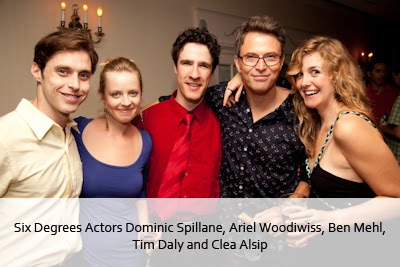
(6) Dominic Spillane, Ariel Woodiwiss, Ben Mehl, Tim Daly, Clea Alsip
(7) Mat Smart, Wes Smart
(8) Lois Smith, David Margulies, Eric Kerns
(9) Candy Buckley, Matt McGrath
(10) Elliot Villar, James Joseph O'Neil
(11) Nick Blaemire, Jesse Lenat, Michael Friedman
(12) Chloe Webb, Ashley Robinson, Kris Kukul, Jo Lampert, Jeff Cuttler
(13) Michele Lowe, Adrienne Campbelle-Holt, Lucas Kavner
(14) Alyssa Rachels, Erica Larocque
(15) Jake DuPree, Kaitlyn Benetz
(16) Julia Locascio, Jacinda Johnson, Brynn Almli
[ ... ]

Thursday, July 15, 2010

Special Feature | Six Degrees of Williamstown


by Kristin Idaszak, Dramaturg

It is a widely acknowledged truism that the theatre community is very small, so the cast and production team of WTF’s Six Degrees of Separation performed our own mini-version of the small world experiment to see just how small it is. If six degrees should connect us to anyone in the world (Nelson Mandela, Tina Fey, Gordon Brown)—how many degrees would it take for us to connect to each other?

I paired people who had never met before this production, from different parts of the country and in different stages in their careers. Each pair was given the task of figuring out what chain of mutual acquaintances connected them, without using anyone else from WTF. Pairs were also discouraged from using Facebook. Still, most of us found that we were only one or two degrees apart.

David Sugarman, Stage Manager (Boston/New York) and Clea Alsip, Tess (San Francisco/New York): 1 degree

From David: “Clea interned with Ted at the Public, who was the musical director of South Pacific at Lincoln Center, which I worked on! At first it seemed like it was going to be hard because she was all West Coast and I was all East Coast and I had never worked at the Public, but then we broke it!”

Kristin Idaszak, Dramaturg (Chicago) and Ben Mehl, Trent (Toronto/New York): 1 degree

From Kristin: “Ben’s Feldenkrais teacher at NYU, Scott, was my first director and mentor, the person who taught me that the arts were essential to a society’s health and who encouraged me to pursue a career in the theatre.”

Sam Hough, Photographer (East Texas/New York) and Ariel Woodiwiss, Elizabeth (North Carolina/New York): 1 degree

From Ariel: “We both know a friend in the city, Julie, who was working at The Studio. Sam was a photographer for their show Big Love and Julie was my roommate in Queens the year we both moved to New York.”

Amber Wedin, Assistant Stage Manager (New York) and Dominic Spillane, Woody (New York): 2 degrees

From Amber: “My best friend Emily, the Company Manager at the Public Theatre, used to work with Dominic's friend Steven.”

Adrienne Campbell-Holt, Assistant Director (Boston/New York) and Michael Bradley Cohen, Dough (Brooklyn, New York): 1 degree

From Adrienne: “So, it turns out Michael Cohen and I are connected through his lovely girlfriend, Chelsea, who worked as an intern for my theater company Colt Coeur during our production of Seven Minutes in Heaven in June.  We loved having Chelsea on our team and she brought Michael to the show and it was only when we played this game that he realized I had directed it...”

Tim Daly, Flan (Vermont/LA) and Caitlin Griffin, Company Management (Connecticut): 6 degrees of separation!

From Caitlin: “Tim is acquainted with Tony S, an alumnus of ART where Skip C is an associate production manager. Skip, the nephew of Karen Macbeth is a co-worker of Meg, my mother.”
[ ... ]

Wednesday, July 14, 2010

Video | This Week at the Festival

Check out what is happening this week at the Festival and see pictures from rehearsals of upcoming projects!


[ ... ]

Dramaturgy | The Art of High Society


by Kristin Idaszak, Dramaturg

“Who said when artists dream they dream of money? I must be such an artist.” – Ouisa Kittredge, Six Degrees of Separation

In the nineteenth century, a new school of artists called Impressionists became the mockery of the art world. Ironically, a century later, these same artists—eg Degas, Monet, Cezanne and Van Gogh—who lived in squalor and oppressive poverty during their lifetimes (often having to barter their artwork for food and art supplies) were now so sought-after that their paintings were drawing in tens of millions of dollars. By the 1980s fine art merged with big business as the nouveau riche desired to be seen as cultured and sophisticated, and by 1983 the New York art market was a $2 billion industry. The auction house Southeby’s exacerbated this phenomenon, employing attractive young women to cultivate potential clients and extending credit for the first time ever so that buyers no longer needed to be able to pay for a painting upfront.

Six Degrees of Separation's protagonist Flan Kittredge is one of these new art dealers, a businessman and art connoisseur buying and selling paintings for more money than the artists whose work he handles could have imagined. These paintings had become part art, part commodity, and more than anything what Flan deals in is social status. In his book American Culture in the 1980s, Graham Thompson points out that art became a marker of social status in an unprecedented way: “What marked the American art world of the 1980s was the degree to which late-nineteenth and twentieth-century art now attracted such sums and the fact that money, business and art became so intimately entwined that the buying and selling of art was as much of a story as the art itself.”

He continues: “Given the close links between art and business during the 1980s, it seems fitting that just as the corporate world of takeovers, mergers and stock dealing which so dominated the shifts in corporate and business structures during the 1980s was dominated by Wall Street and other Manhattan financial institutions, so the art market and the art scene was dominated by Manhattan…Art became one of the places in which the new money unleashed by economic growth in the 1980s revealed itself through conspicuous consumption.”

Art dealers became critical liaisons between artists and the entire world of high finance. The cutthroat industry became increasingly less about artistic integrity and increasingly more about money and status. Southeby’s owner said about the industry, “Selling art has much in common with selling root beer. People don’t need root beer and they don’t need to buy a painting either. We provide them with a sense that it will provide a happier existence.” But some dealers, like Flan, disparaged this viewpoint as well as the larger phenomenon of high art’s commodification, even though it was inescapable. These were the men and women who remembered Vasily Kandinsky’s mandate that “the artist must train not only his eye but also his soul.”
[ ... ]

Tuesday, July 13, 2010

Interview | Antje Ellerman Six Degrees of Separation Scenic Designer

Kristin Idaszak: You mentioned during your design presentation that you and Anne Kauffman [Six Degrees of Separation Director] started off talking about a blank stage, an empty void. But the set is actually quite elaborate. How did you get to the design we have now?

Antje Ellerman: We didn’t linger very long in the void. I know this play has been done in a more minimal or abstract way, but we wanted to do something different. We wanted to create a more specific environment for the characters, which could then be fragmented.

I looked at the architecture of the Upper East Side—these apartment buildings and mansions—to get a sense of layout—where the front hall is, how the living room is situated in relationship to the rest of the apartment. I wanted to understand the logic of it so I could come up with our own version. I started with a very traditional theatre ground plan of a box set, and played around with different ways to fracture that and move it. I felt that the way it moves is equally important to where it lands. We didn’t want for pieces just to slide off or to fly, but to break apart the set in a more three dimensional way.

Once I figured that out and showed Anne, it really became about adjusting the ground plan—making it more intimate, figuring out the spacing of the entrances. A lot of the work happened in our heads. We didn’t slog through a whole lot of models; it was more about thinking about it carefully and then trying to put it together.

KI: That’s fascinating. One of the things that struck me about your design is what a striking manifestation it is of the psychological reality of the play, that there is this sense of fracture.

AE: What I wanted to do was start with something that seemed simple and then open that up. One thing that informed the design was that John [Guare] said he was interested in the way Ouisa’s and Flan’s lives cracked open when Ouisa discovers the hustler in her house. It’s something she doesn’t expect, this horrible thing that’s happened in the sanctity of her home. This couple is very well-established and comfortable with themselves until this event unsettles her and changes her life. So we wanted there to be a fissure in the set. Also, the play at times feels farcical with all these entrances and exits, everyone constantly coming and going, so I wanted to create a way for people to enter the space that might not be through a door or in a conventional way.

KI: Absolutely. Something else that John said in rehearsal was that this play is about discovering that unknown country within ourselves, and the set really reflects that.

AE: Thank you. There’s a line in the play—Ouisa says that every person is a door into a new world, and I wanted to create these different views and different openings for people to appear.

KI: What about the artists mentioned in the play—of course there’s the large Kandinsky onstage, but otherwise, did they enter into your process at all?

AE: I knew I needed to create an environment in which the Kandinsky could exist, but I didn’t feel it was about the particular artwork so much as the emotions behind it. I think it provides a context for the environment and the characters. I felt like it was unnecessary to comment on that with the set. With the costumes, the people themselves onstage will be the focal point, and the set will really be a canvas for them. For this design, I was more influenced by architecture than the modern art in the play. I did research, because I was curious, the double-sided Kandinsky, and whether that was a real piece of art [which it’s not]. I discovered that Kandinsky’s work is very colorful, but I decided to just let that be what it is.

KI: This is your first time at Williamstown, right?

AE: Yes, and my first time working with Anne. It’s going to be an adventure! I met Anne a few years ago when I was working with Les Waters. He recommended that I get in touch with her, and we had a really wonderful first meeting about nothing in particular. So I was thrilled when the opportunity to work with her came about!

KI: Well thank you so much. I can’t wait to see what the set looks like when it’s actually built and loaded into the theatre!
[ ... ]

Monday, July 12, 2010

Video | John Guare, Playwright of Six Degrees of Separation

Interview with John Guare, Playwright of Six Degrees of Separation


[ ... ]

Weekly Preview | July 12-18


SIX DEGREES OF
SEPARATION

BY JOHN GUARE
DIRECTED BY ANNE KAUFFMAN
 

Opens this Week!
JULY 14 THROUGH JULY 25
We're all connected...or are we? This Olivier Award winner and Pulitzer finalist stirs the pot of privilege with often hilarious and ultimately heartbreaking results. Don't miss this sensational masterpiece of interconnected worlds.


Tickets can be purchased by phone at (413) 597-3400, in person at 1000 Main Street in Williamstown, or by clicking here.


While you're waiting to see the show, check out these rehearsal photos and this video interview with playwright John Guare.


Ato Essandoh (background), Margaret Colin and Tim Daly
Photo by Sam Hough


Clea Alsip and Ato Essandoh
Photo by Sam Hough


Margaret Colin, Tim Daly and director Anne Kauffman
Photo by Sam Hough
Click here to go to our YouTube Channel to see other behind the scenes videos!


SAMUEL J. AND K.
A WORLD PREMIERE BY MAT SMART
DIRECTED BY JUSTIN WALDMAN
Justin Long and Owiso Odera. Photo by T. Charles Erickson

"There is nothing incomplete in either Long and Odera's finely-tuned performances or Justin Waldman's richly nuanced direction, which insight-fully catches the yearnings of lives reaching for a place called 'home.'"
-The Berkshire Eagle


"Their journey is a pleasure to watch from beginning to end and theatre lovers must hope for more from Mat Smart's pen."
-In the Spotlight

"energetic drama with superb actors"
-Berkshire Fine Arts

"excellent acting on display...WTF is to be commended for continuing to give the Berkshire audience a chance to experience new plays."
-Curtain Up

"the emotional depths both Long and Odera convey--their bond is filled with love and need--keep the play grounded."
-Albany Times Union

Not convinced?
Click here to see what our audiences thought!


SAMUEL J. AND K.
NOW THROUGH JULY 18
A WORLD PREMIERE
by Mat Smart
directed by Justin Waldman

Tickets can be purchased by phone at (413) 597-3400, in person at 1000 Main Street in Williamstown, or by clicking here.


WAMC's THE ROUNDTABLE will broadcast LIVE from WTF this Friday, July 16 and we want a LIVE AUDIENCE!

9AM to NOON on the MAIN STAGE
Come for any, or all!
Admission is free, but seating will be limited.


Come get the inside scoop on our upcoming shows while watching LIVE interviews with WTF actors, directors and playwrights and WAMC's Alan Chartock, Joe Donahue and Sarah LaDuke!


Here are some great photos from last year:


The Roundtable's Sarah LaDuke and Dylan Baker
Photo by Sam Hough


Artistic Director Nicholas Martin
Photo by Sam Hough


Playwright Noah Haidle and Wende Malick
Photo by Sam Hough


FRIDAYS @3 is WTF's original play reading series.Join us for the first look at America's finest new plays read by festival artists. Here's what's coming up this week:

FRIDAY, JULY 16
GOOD ON PAPER by Michele Lowe
For a community service credit, 16-year-old Miles returns to the daycare center at his father's office where he himself was cared for as a small boy. Even though he has never really understood why his dad left him and his mom, Miles knows it has something to do with this place, once a revolutionary program for children of working parents. Michele Lowe's Good On Paper asks us to question when we feel--and when we actually are--safe.

Readings take place in Paresky Center and there is a $5 suggested donation. Reservations are recommended and can be made through the Box Office by calling (413) 597-3400.

For more information on what readings are coming up, check out our blog here!


MONDAY, AUGUST 2
THE NAUGHTONS IN CONCERT
2010 WTF Email Banner
Don't miss Greg and James Naughton as they return to Williamstown this summer for ONE NIGHT ONLY in a special benefit performance!

7PM on the WTF Main Stage
Tickets are $50 for orchestra, $40 for first balcony and $25 for second balcony.
Click here to buy tickets!


JULY 13
2010 WTF Email BannerSAMUEL J. and K.
Join us for a talkback following the performance on Tuesday, with cast members Justin Long, Owiso Odera and dramaturg Sarah Slight.

 
JULY 202010 WTF Email BannerSIX DEGREES OF SEPARATIONSarah LaDuke from WAMC's The Roundtable will be on the panel for this talkback.


JULY 23
SPECIAL FRIDAY TALKBACK!
2010 WTF Email BannerAFTER THE REVOLUTIONBerkshire Daily Editor, Seth Rogovoy will be conducting a special talkback for this thought-provoking play.
2010 WTF Email 
Banner
 
AUGUST 3
OUR TOWN
Joe Donahue from WAMC's The Roundtable will be here on Talkback night to discuss his favorite play, OUR TOWN.


FELLOWSHIP MUSICAL:
WESTERN COUNTRY
JULY 19-20 AT 7PM & 11PM
IN THE DIRECTING STUDIO
directed by the 2010 Boris Sagal Directing Fellow,  DAVIS McCULLUM
book and lyrics by NOAH HAIDLE
music by,  KELLYS COLLINS & RYAN TYNDELL
music direction by,  MATT CITRON


Emily Simoness, a Non-Equity Company member, with Matt Cintron and Ryan Tyndell performing the opening number at the 2010 Opening Night Celebration.
Photo by Sam Hough.


ADMISSION IS FREE, BUT RESERVATIONS ARE A MUST AND CAN BE MADE THROUGH THE WTF BOX OFFICE AT (413) 597-3400
[ ... ]